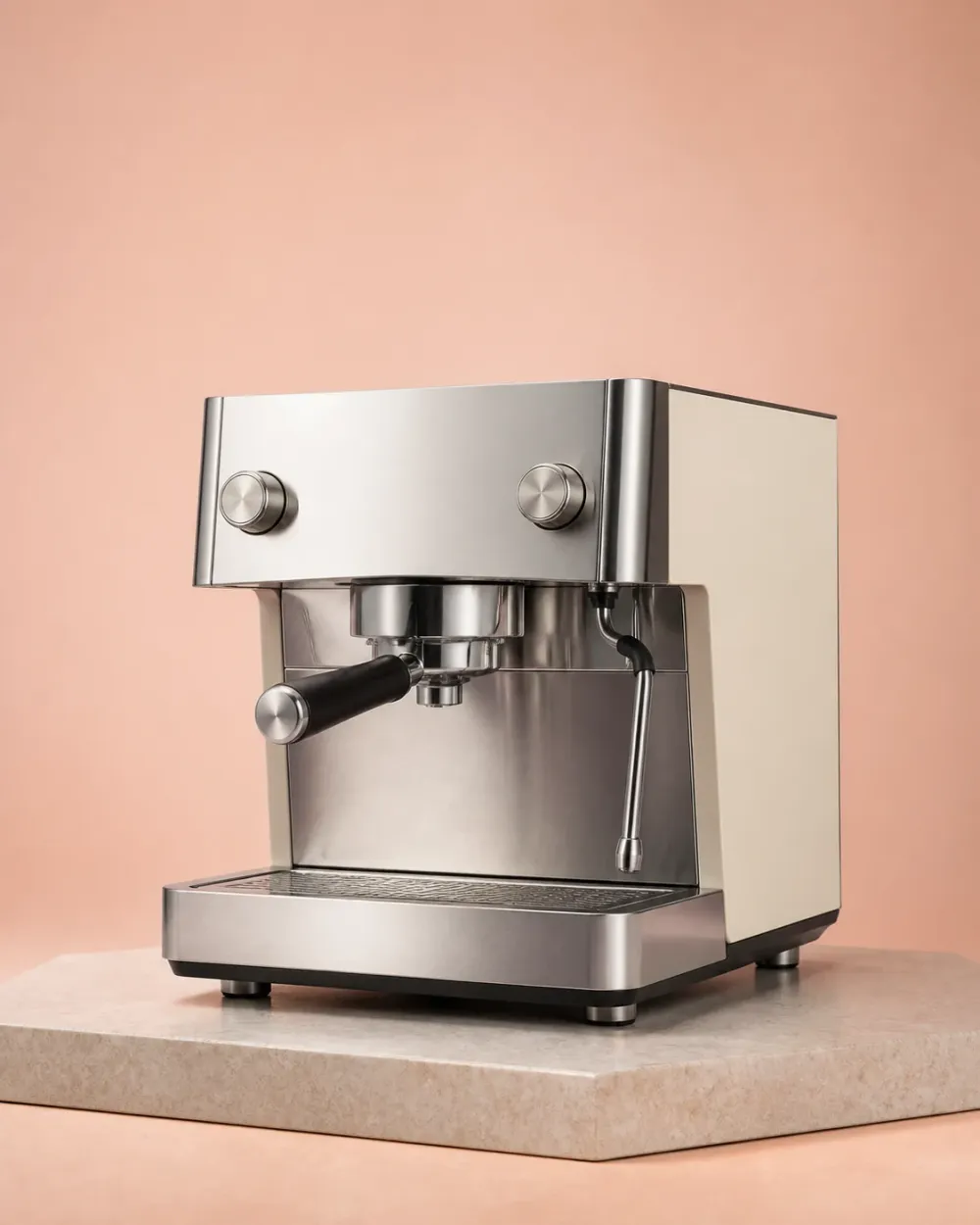

Brioso Piccolo E1 review: café pressure on a 24 cm footprint
A proper 58 mm group and PID control in the smallest machine Brioso makes. One boiler, though — and you will feel it every time you want milk.
The verdict
Best OverallStrong buy
Recommended without caveats for most people.
The Piccolo E1 holds brew temperature within 0.4 C across twelve consecutive shots, takes standard 58 mm accessories, and has a published parts diagram. For someone learning espresso properly, that combination at $749 is close to unbeatable. It is also a single-boiler machine with a 55-second wait between brewing and steaming, and no documentation worth reading. Brioso has made a professional's machine and priced it for a beginner without explaining it to one.
- Buy it if
- You want to learn espresso properly and expect to still own the machine in ten years.
- Skip it if
- You mostly drink milk drinks for two people, or you want it to work well without reading anything.
Tested for seven weeks and about 320 shots. Bought at retail with our own money. How we test
Pros and cons
Pros
- Temperature stability that matches machines at twice the price
- Standard 58 mm group takes any basket, tamper, or distributor
- Full parts diagram published, and parts sold directly
- Genuinely small for what it is
Cons
- Single boiler means a 55-second wait between espresso and steam
- Sixteen minutes from cold before the temperature settles
- The manual explains almost nothing
- No pressure gauge on the group, only on the pump
The difference between a machine that makes good espresso and a machine that makes the same espresso twice is temperature stability, and it is the specification most often quoted and least often measured.
- 0.4C
- Temperature swing, 12 shots
- 16min
- Warm-up to stable
- 55s
- Brew to steam
Class average: 1.9 C
Temperature
We log brew water temperature with a thermocouple in a Scace device, pulling twelve shots back to back at two-minute intervals after a full warm-up. What we are looking for is not the absolute number — that can be dialled in — but the spread.
| Test | Result | Class average |
|---|---|---|
| Temperature spread, 12 shots | 0.4 C | 1.9 C |
| Shot-to-shot repeatability | 0.2 C | 0.9 C |
| Warm-up to stable | 16 min | 22 min |
| Recovery after steam | 48 s | 71 s |
| Pressure at the group | 9.1 bar | 9.4 bar |
Twelve consecutive 30-second shots at two-minute intervals, Scace device, after 20 minutes of warm-up. Reference is the mean of five single-boiler PID machines between $600 and $900.
Four tenths of a degree over twelve shots is a result we would expect from a dual-boiler machine at twice the money. It is the single best thing about the Piccolo and the reason a beginner will improve faster on it than on almost anything else at the price: when a shot tastes different, it is because something you did was different.
The single-boiler problem
Fifty-five seconds. That is how long the machine takes to go from brew temperature to steam temperature, and it is not optional — you pull the shot, press the switch, wait, steam, then wait again for it to come back down before the next one.
For one flat white in the morning this is a mild inconvenience. For two people wanting milk drinks at the same time it is the defining characteristic of the machine, and no amount of temperature stability compensates.
Living with it
The E1 assumes you already know things. There is no guidance on dose, no starting grind recommendation, no explanation of why the first shot after warm-up will be different, and the four-page manual spends two of those pages on descaling.
What you get instead is a machine that does not get in the way once you know what you are doing: 58 mm standard everything, so any basket, any tamper, any distributor; an OPV set correctly at the factory to 9 bar; and a parts diagram that means the gasket you will need in three years is a $4 part rather than a service visit.
The verdict
If you are one person who drinks espresso and wants to get properly good at it, this is the machine. If you are two people who drink cappuccinos, the wait will wear you down long before the temperature stability wins you over.
How it scored
Weighted average of 6 criteria
- Temperature stability9.322%
Plus or minus 0.4 C over twelve back-to-back shots.
- Shot quality9.022%
With a decent grinder, extraction is even and repeatable.
- Steam performance6.417%
Enough power for one jug. The wait to get there is the problem.
- Build and serviceability9.517%
Standard parts, full diagrams, nothing glued.
- Ease of use5.811%
Assumes knowledge it does not supply. The manual is four pages.
- Footprint and warm-up7.511%
24 cm wide, but 16 minutes from cold to stable.
Overall8.2/10
Specifications
Brewing
| Boiler | 300 ml brass, single |
|---|---|
| Temperature control | PID, adjustable in 1 C steps |
| Temperature stability | Plus or minus 0.4 C over 12 shots |
| Group | 58 mm, E61-derived |
Steam and water
| Steam wand | 2-hole, articulated |
|---|---|
| Time to steam from brew | 55 seconds measured |
| Water tank | 2.4 litres, front accessible |
Physical
| Dimensions | 240 x 400 x 340 mm |
|---|---|
| Weight | 14.2 kg |
| Warm-up to stable | 16 minutes measured |
Where to buy the Piccolo E1
- Brioso DirectCheck price for the Piccolo E1 at Brioso Direct (opens in a new tab)
- Crema WorksIncludes a bottomless portafilterCheck price for the Piccolo E1 at Crema Works (opens in a new tab)
We earn a commission when you buy through these links. It never changes what we recommend, and we buy every unit we test. How we stay independent.