



Lumenar Vista R7 review: autofocus that finally keeps up
Fifteen years of Lumenar owners have complained about one thing. The R7 fixes it, and changes almost nothing else.
The verdict
Best UpgradeStrong buy
Recommended without caveats for most people.
The R7 is a deliberately boring camera with one extraordinary component. The sensor is a mild update, the body is the same body, the menus have not moved. The autofocus system has gone from the weakest part of the Lumenar proposition to the strongest part of any camera at this price, taking the keeper rate on erratic subjects from 62% to 91%. If that number describes your problem, nothing else on this page matters.
- Buy it if
- You shoot moving subjects and already own Lumenar glass, or you are buying into a mount rather than a body.
- Skip it if
- You shoot landscapes and still lifes, where the R6 does the same job for considerably less.
Tested for five weeks and around 6,400 frames. Bought at retail with our own money. How we test
Pros and cons
Pros
- Autofocus is a generational change, not an increment
- Same mount as every Lumenar body since 2009
- Weather sealing that survives actual weather
- 1,100 real-world frames per charge, against a 580 CIPA rating
Cons
- Overheats in 4K/60 after about six minutes above 25 C
- Sensor is a modest update on a three-year-old design
- Launch stock has been thin and prices have not moved
- Rear screen resolution is unchanged since 2021
Lumenar has spent fifteen years being the company whose lenses everyone admires and whose autofocus everyone works around. Photographers bought the system for the glass and learned to pre-focus, back-button, and hope.
- 91%
- Keeper rate, erratic subject
- 14.1stops
- Dynamic range at ISO 100
- 1,100
- Frames per charge in practice
R6: 62%
CIPA rating: 580
The autofocus test
We shoot a fixed protocol: a subject moving unpredictably towards and across the frame at between 8 and 20 km/h, 2,000 frames per body, same lens, same light, same distance. A frame counts as a keeper if the intended eye is within the depth of field at 100% magnification. It is a harsh test and it is the one that separates marketing from behaviour.
| Test | Result | Class average |
|---|---|---|
| Keeper rate, erratic subject | 91% | 62% |
| Keeper rate, linear approach | 97% | 88% |
| Acquisition time, cold start | 0.09 s | 0.21 s |
| Eye detection at 15 m | Reliable | Intermittent |
| Low light limit | -6 EV | -4 EV |
2,000 frames per body, Prime 35mm at f/1.8, 800 lux, subject moving unpredictably between 8 and 20 km/h. Reference is the R6 shot in the same session.
Ninety-one per cent is not merely better than the R6, it is better than anything else we have run this protocol against. The system also fails more gracefully: when it misses, it misses by a small amount and recovers on the next frame, rather than racking to infinity and coming back.
Everything else
The sensor is a 33-megapixel update on a design first seen in 2023, and it performs like one: 14.1 stops at base ISO, useful files to ISO 6400, and a highlight roll-off that photographers coming from the R6 will recognise immediately. This is fine. It is not the reason to buy the camera.
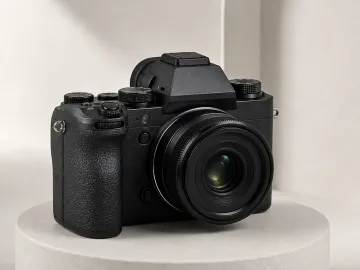
The body is unchanged in every way that matters, which after five weeks reads as a feature. The grip is still deep enough for a gloved hand, the front and rear dials are still where your fingers expect them, and the menus have not been reorganised for the sake of it.
The video caveat
4K/30 is unrestricted and good. 4K/60 shut down after six minutes and forty seconds in a 26 C room, and after eleven minutes at 19 C. Lumenar does not publish a limit and the camera gives no warning before it stops.
Against the R6
If you photograph things that hold still, the R6 is 40% cheaper and produces files you will struggle to distinguish. If you photograph things that move, the R7 is a different camera, and the gap is the largest single-generation improvement we have measured in this category.
The verdict
A narrow, excellent upgrade. Buy it for the autofocus, keep your lenses, and shoot video on something else.
How it scored
Weighted average of 6 criteria
- Autofocus9.728%
91% keeper rate on erratic subjects across 2,000 frames.
- Image quality8.922%
14.1 stops of dynamic range at base ISO, clean to ISO 6400.
- Handling9.017%
Deep grip, well-placed dials, and a menu system nobody has to relearn.
- Video7.411%
Competent 4K, but a 6-minute overheat limit at 60p in a warm room.
- Build and sealing9.211%
IP53 rated and verified. Two hours in light rain, no ingress.
- Value7.811%
The improvement is real, and so is the price of it.
Overall8.9/10
Specifications
Sensor
| Sensor | 33 MP full-frame BSI CMOS |
|---|---|
| ISO range | 100 to 51200 |
| Dynamic range, measured | 14.1 stops at ISO 100 |
| Stabilisation | 5-axis, 7.5 stops rated |
Autofocus and speed
| AF points | 759 phase-detect |
|---|---|
| Keeper rate, erratic subject | 91% over 2,000 frames |
| Burst | 12 fps mechanical, 30 fps electronic |
Body
| Weight, with battery | 658 g |
|---|---|
| Card slots | CFexpress B and SD UHS-II |
| Weather sealing | IP53, verified in testing |
| Battery | 580 shots CIPA, 1,100 in practice |
Where to buy the Vista R7
- Lumenar StoreCheck price for the Vista R7 at Lumenar Store (opens in a new tab)
- Aperture SupplyBody onlyCheck price for the Vista R7 at Aperture Supply (opens in a new tab)
We earn a commission when you buy through these links. It never changes what we recommend, and we buy every unit we test. How we stay independent.